

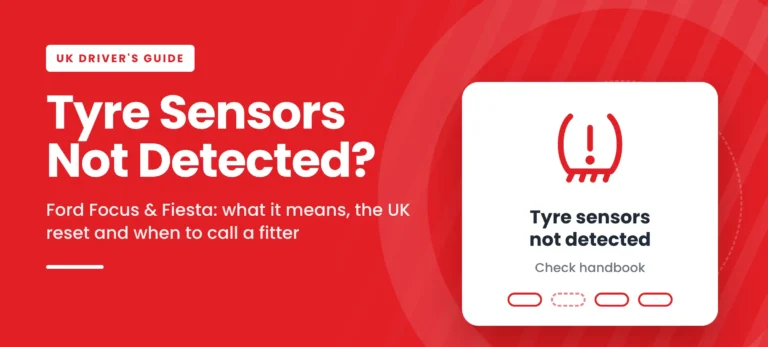
Tyre Sensors Not Detected on a Ford Focus: What It Means and
How to Fix It
If your dashboard has just shown “Tyre sensors not detected check handbook”, your Ford isn’t telling you a tyre is flat. It’s telling you the tyre pressure system has stopped hearing from the wheels. When tyre sensors are not detected on a Ford Focus, the list of causes is short, and most of them can be narrowed down on your driveway with a gauge and five minutes.
This guide covers the Focus first, with the Fiesta alongside throughout (it uses the same systems) and a short note on the Kuga near the end. You’ll find what the message means, the quick checks worth doing first, the reset that actually works on UK cars, how to tell when a sensor has died, where you stand with the MOT, and when it makes sense to get a mobile fitter out to sort it at home or work.
What Tyre Sensors Not Detected Actually Means
Tyre sensors not detected means your Ford’s tyre pressure monitoring system is getting no signal from the wheel sensors, so it can’t monitor your tyre pressures at all. Ford gives two reasons for the message: either wheels and tyres without sensors have been fitted, or all of the sensors have failed or an unapproved accessory is interfering with the system. That’s what Ford’s manual says the message means, and Ford advises getting the system checked by a trained technician promptly.
The key point: this is a system message, not a low-pressure warning. A low-pressure warning means the car has measured a soft tyre. “Not detected” means the car has no pressure information to go on. Your tyres could all be spot on, or one could be going down, and the dash can’t tell you which. The warning lamp gives you a second clue. Here’s how to read it:
| What you see | What it means |
|---|---|
| Tyre warning lamp lit and steady | The system has picked up pressure loss in one or more tyres. |
| Lamp flashes for a while, then stays lit | The monitoring system itself has a fault. |
| "Tyre sensors not detected" on the display | No sensor signal is reaching the car. |
If the lamp flashes before settling, or the message is on screen, start by finding out whether the fault is in the monitoring or in a tyre. The checks below do exactly that.
First, Does Your Ford Even Have Tyre Sensors? DDS vs TPMS
Not every Focus or Fiesta has a sensor inside each wheel, and this is where most online advice goes wrong. Ford uses two different systems, and the one your car has decides what can and can’t be wrong with it.
Direct TPMS: a sensor in every wheel
Each wheel carries a small sensor at the valve, inside the tyre. It measures the pressure and transmits it to a receiver in the car, and its battery is sealed inside the unit. These cars can genuinely lose a sensor.
Deflation Detection System (DDS): nothing in the wheels
DDS doesn’t use in-wheel sensors at all. As Ford’s own handbook page on the Deflation Detection System explains, it uses the ABS sensors to watch the rolling circumference of each wheel. A tyre that loses air rolls on a smaller circumference, and the system notices the change. On a DDS car there’s no sensor to die, no battery to replace and nothing to programme.
How to tell which one you have
- Read the tyre pressure section of your handbook. If it talks about the Deflation Detection System, your car has DDS. If it talks about sensors, sensor positions or a tyre monitor, it's direct.
- Look in the cluster's SET menu. A "T. Pres" option is the DDS reset.
- Check whether the display ever shows a reading for each tyre. If it does, you have sensors. If not, that proves nothing either way.
Fitment varies by year, trim and market. Plenty of Mk3 Focus and Mk7 Fiesta cars left the factory with DDS while others from the same range have in-wheel sensors, so check yours. If yours turns out to be DDS, skip the sensor causes later on and concentrate on pressures, the reset and the DDS triggers.
First, Does Your Ford Even Have Tyre Sensors? DDS vs TPMS
Not every Focus or Fiesta has a sensor inside each wheel, and this is where most online advice goes wrong. Ford uses two different systems, and the one your car has decides what can and can’t be wrong with it.
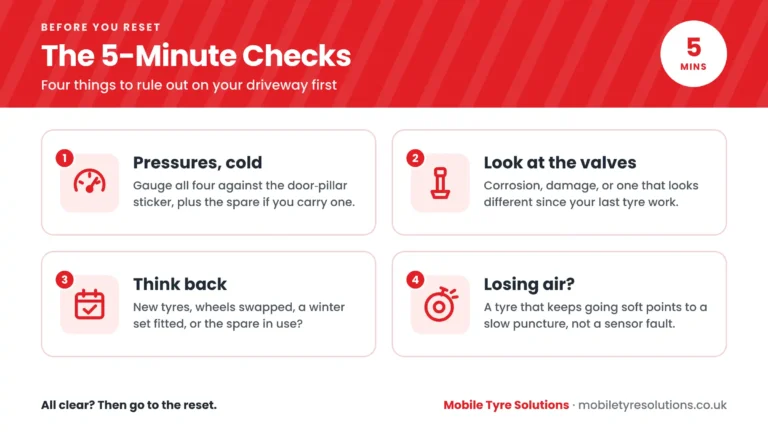
- Check all four pressures with a gauge, with the tyres cold. Use the figures on the sticker in the driver's door pillar or in your handbook, not a number from the internet, because the right pressure depends on tyre size and load. TyreSafe's guide to checking pressures with a gauge walks you through it. If you carry a spare, check that as well.
- Look at the valves. Corrosion, a bent or damaged valve, or one that looks different since your last tyre work is worth noting.
- Think back over the last few weeks. New tyres? Wheels swapped front to back? A second set of wheels on for winter? The spare in use? Each of these points to a specific cause covered below.
Ask whether a tyre is really losing air. If one keeps needing topping up, looks softer than the rest or has a screw in the tread, you may have a slow puncture rather than a sensor fault. That’s a job for mobile puncture repair, not a reset.
How to Reset or Store Tyre Pressures on a UK Ford Focus or Fiesta
The Focus and Fiesta share the same two systems, so the same two routes apply. Whichever you have, the rule doesn’t change: get the pressures right first, then reset. The reset stores whatever is in the tyres at that moment as the new normal.
If your car has DDS (no wheel sensors)
- Set all four tyres to the correct pressure.
- Park up and turn the ignition on. The system won’t reset while you’re moving.
- In the cluster menu, go to SET > T. Pres.
- Press and hold SET/RESET until the display confirms “Tyre Pressure set”. Some clusters word the menu slightly differently and ask you to hold SET to set tyre pressure.
If your car has direct TPMS (sensors in the wheels)
- Set all four pressures correctly.
- With the ignition on, go to Settings, then Information or Driver Assist, then Tyre Pressure or Tyre Monitor.
- Press and hold OK until the confirmation appears.
- The system relearns as you go, and the light can take several minutes of driving above about 25 mph (40 km/h) to go out.
Will It Fail the MOT?
It can. Under the MOT inspection manual’s TPMS section (GOV.UK), the tyre pressure monitoring system is inspected on passenger cars (M1 vehicles) first used on or after 1 January 2012. A system that is malfunctioning or obviously not working is a major defect, which means a fail.
What isn’t a fail: a warning lamp that’s only reporting low pressure. The dashboard messages aren’t defects in their own right either; the tester uses them to judge whether the lamp is showing a fault. Where it’s unclear whether the lamp means a fault or simply low pressure, you get an advisory rather than a fail.
So on a 2012-or-later car with a dead sensor, sort it before test day, not at the test centre. Disabling the system isn’t a fix: it’s tested equipment, and switching it off just leaves you driving unmonitored.
When It's Time to Call a Mobile Fitter
If the reset won’t hold, or one wheel keeps dropping off the display, it’s time to get it looked at. We come to your home or work in Oldham, Rochdale, Bury, Stockport and Bolton, and we cover mobile tyre fitting in Manchester too.
