

What Is the Legal Tyre Tread Depth in the UK, and Will Tyres Fail an MOT?
The tread on your tyres looks thin. Maybe last year’s MOT sheet carried a tyre advisory, or the test is next week and you’d rather not find out at the garage.
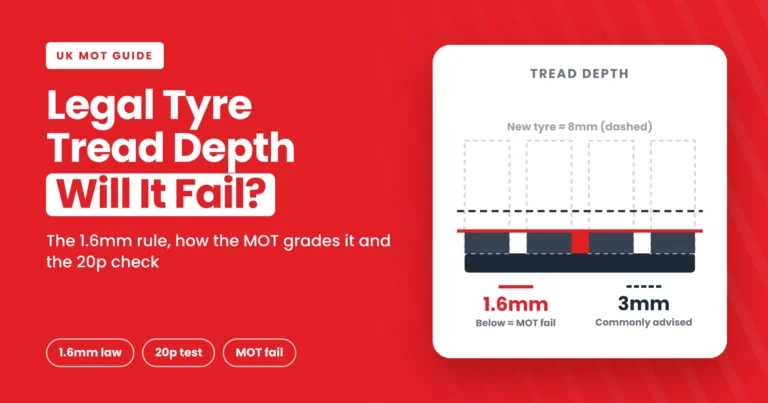
The legal tyre tread depth in the UK is 1.6mm for cars, measured across the central three-quarters of the tread and all the way round the tyre. And yes, tyres below that fail an MOT. Worn tread under the limit is classed as a Dangerous defect, so the car fails and shouldn’t be driven until the tyre is replaced.
This guide covers what the rule means in practice, how the MOT grades tyre wear, a two-minute coin check you can do on the drive, why 1.6mm is a floor rather than a target, and what illegal tread can cost you.
What Is the Legal Tyre Tread Depth in the UK?
For cars, light vans and light trailers, the minimum is 1.6mm. The rule has three parts, and a tyre has to meet all of them.
Central three-quarters. The depth is measured across the middle three-quarters of the tread’s width. Under the tread rule on its own, the strips either side of that band can be bald. Don’t read that as a free pass: a tyre worn down on one edge still picks up an MOT advisory and still needs dealing with.
Full circumference. The 1.6mm has to hold right round the tyre. A single worn patch anywhere in that central band makes the tyre illegal, so checking one spot tells you very little.
Primary grooves only. What counts are the main grooves: the ones that carry the tread-wear indicators, or that were as deep as those when the tyre was new. Shallower secondary grooves aren’t measured.
Other vehicles work to different limits:
Vehicle |
Legal minimum |
|---|---|
| Cars, light vans, light trailers | 1.6mm |
| Motorcycles over 50cc, large vehicles, passenger vehicles with more than 8 seats | 1.0mm |
| Mopeds and motorcycles up to 50cc | Original tread pattern clearly visible |
One more detail: the MOT only inspects the tyres fitted to the car. A worn spare gets an advisory, not a fail.
Will Tyres Fail an MOT for Tread Depth?
Yes. The MOT inspection manual covers tread under section 5.2.3, and tread that doesn’t meet the requirement is listed as a Dangerous defect. That’s the most serious grade there is. The car fails, and it must not be driven until the tyre has been changed. No repair brings worn tread back, so before a retest you’re looking at a tyre replacement
Not every tyre note on an MOT is a fail, though. Here’s how the common tyre results compare:
MOT grade |
Tyre issue |
Result |
|---|---|---|
| Dangerous | Tread below the legal requirement | Fail. Do not drive until replaced |
| Major | Tyre pressure monitoring system faulty (shown for comparison) | Fail |
| Minor | Tyre obviously under-inflated | Pass, defect recorded |
| Advisory | Tyre worn close to the legal limit, or worn on the edge | Pass. Plan a replacement |
An advisory names the tyre, such as nearside front or offside rear, so you know exactly which one to keep an eye on.
Bear in mind that an MOT pass describes the car on the day of the test and nothing more. Tyres carry on wearing after you drive away, so a tyre that scraped through in spring can be illegal by autumn. Keeping the tread above 1.6mm is the driver’s job every time the car moves, not the tester’s once a year.
How to Check Your Tyre Tread Depth
The quickest home check is the 20p test. All you need is a coin.
- Push a 20p into one of the main grooves of the tyre.
- Look at the coin's outer band, the raised rim running round its edge. If the band is hidden, the tread is above the legal limit at that point.
- If you can see the band, the tread may be below 1.6mm. Have it looked at by a tyre professional straight away
- Move the coin and repeat at three or more points around the tyre.
- Do the same on all four tyres.
Treat the coin as a quick screen rather than a measurement. For an exact figure, use a tread depth gauge: press its probe into a main groove until the base sits flat on the tread, then read off the millimetres.
Your tyres also carry their own markers. Tread-wear indicators are small raised bars moulded across the bottom of the main grooves at 1.6mm. Once the tread surface has worn down level with those bars, the tyre has reached the legal limit.
Make it a habit: check at least once a month, and before any long journey.
Is 1.6mm Enough, or Should You Replace at 3mm?
1.6mm is the lowest depth the law will accept. It isn’t a safety target, and it isn’t where a tyre does its best work.
Tread grooves are there to channel water out from under the tyre. As they get shallower, they shift less of it, grip on wet roads falls away and the chance of aquaplaning climbs. In MIRA tests reported by TyreSafe and the RAC, cars on 1.6mm tread needed up to 44% more distance to stop in the wet than cars on 3mm.
That’s why the RAC’s tyre tread guide and TyreSafe commonly advise replacing tyres at around 3mm. To be clear, 3mm is advice, not law. A tyre at 3mm is legal and won’t fail its MOT on tread depth. For comparison, a new car tyre usually starts with around 8mm.
What Else Can Fail an MOT on Tyres?
Tread isn’t the only tyre item on the MOT checklist. Damage is graded too. A lump, bulge or tear, or cords showing through the rubber, counts as Dangerous, which means a fail and a car that stays off the road. A deep cut that reaches the ply or cords is graded Major, which is also a fail.
What Is the Fine for Illegal Tyre Tread?
Driving on tread below the legal limit can cost up to £2,500 and 3 penalty points for each illegal tyre. Because the penalty applies per tyre, it mounts quickly:
- One tyre: up to £2,500 and 3 points
- Two tyres: up to £5,000 and 6 points
- Three tyres: up to £7,500 and 9 points
- Four tyres: up to £10,000 and 12 points, which can lead to a driving ban
- Do the same on all four tyres.
There’s an insurance angle as well: if you’re in an accident on illegal tyres, your claim may be affected. Against those figures, replacing a worn tyre is the easy decision.
Frequently Asked Questions
What is the legal minimum tyre tread depth in the UK?
For cars, light vans and light trailers, it’s 1.6mm. It applies in the primary grooves, across the central three-quarters of the tread and around the whole tyre. Motorcycles over 50cc, large vehicles and passenger vehicles with over eight seats need 1mm; mopeds need a clearly visible tread pattern.
Will my car fail its MOT if the tyre tread is below 1.6mm?
Yes. Under section 5.2.3(e) of the MOT inspection manual, tread below the legal requirement is a Dangerous defect. The car fails and must not be driven until the tyre is replaced. A worn tyre can’t be made legal; replacing it is the only fix.
What does "tyre worn close to the legal limit" mean on my MOT?
It’s an advisory, not a fail. Your car passed, but the tester has flagged one tyre, such as the offside rear, as nearly down to 1.6mm. Plan to replace it soon: it’s likely to fail next year and becomes illegal as soon as it drops below the limit.
How do I check tyre tread depth with a 20p coin?
Place a 20p in a main groove and look at the coin’s outer band. Hidden means the tread is above the legal limit; visible means it may be below, so get it checked now. Test three or more points on every tyre, and use a gauge for an exact reading.
What is the fine for driving with tyres below the legal tread depth?
Up to £2,500 and 3 penalty points for every illegal tyre. If all four are below the limit, that adds up to £10,000 and 12 points, which can lead to a driving ban. An accident on illegal tyres may also affect your insurance claim.
Tyre Below the Limit? Let the Fitter Come to You
Failed on tread, or can you see the band on the 20p? Leave the car where it is. A tyre with a Dangerous defect isn’t safe to drive, not even the short trip to a garage, so the right fix is a fitter who comes to you. Mobile Tyre Solutions offers mobile tyre replacement across the UK, fitting the new tyre at your home, at work or at the roadside.
