

Tyre Pressure Warning Light: What It Means and What to Do
The tyre pressure warning light has just come on, maybe halfway along the motorway, maybe on a frosty morning before you’ve left the drive. Here’s what it means: at least one tyre has dropped roughly 25% below its recommended pressure, or the monitoring system itself has developed a fault.
What to do now: pull over somewhere safe, look at all four tyres, then check them with a gauge and inflate to the figure printed inside your driver’s door frame. If a tyre is flat or damaged, don’t drive on it.
The rest of this guide, written by mobile fitters, covers what the tyre pressure light looks like, whether you can keep driving, the seven usual causes, how to reset it, and when it turns into an MOT problem.
What Does the Tyre Pressure Warning Light Look Like?
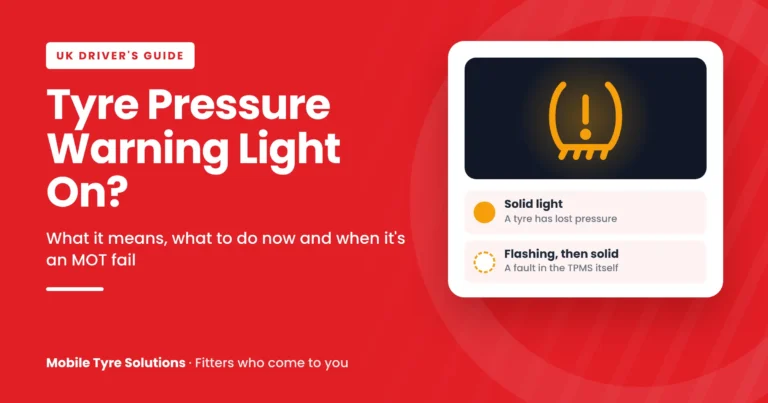
It’s an amber horseshoe shape, a cross-section of a tyre, with an exclamation mark in the middle. That’s the standard tyre pressure indicator, and most drivers simply call it the tyre pressure sign. Some cars pair it with a message on the display, so it reads as a tyre pressure low sign with words underneath.
Officially it’s the tyre pressure monitoring system warning light, or TPMS for short, and how it behaves tells you more than the symbol does:
What you see |
What it usually means |
|---|---|
| Solid light | One or more tyres has lost pressure |
| Flashing tyre pressure light for 60–90 seconds at start-up, then solid | A fault in the system itself: a dead sensor battery, or a failed or missing sensor |
| Comes on in the morning, goes off later | A cold-weather pressure drop |
| Comes on after a tyre change | The system needs a reset or relearn |
Cars use one of two systems. Direct TPMS has a sensor in each wheel that reads the pressure itself. Indirect TPMS has no wheel sensors; it uses the ABS sensors to spot a tyre turning faster than the others as it loses air. If your dash reports that it can’t find the sensors at all, our guide to tyre sensors not detected covers that message.
TyreSafe’s guide to TPMS explains both systems and makes a point worth repeating: the TPMS light is a back-up, not a substitute for checking your own tyres. Whatever your car calls it, a warning light for tyre pressure is a prompt to check, not a diagnosis, and the TPMS warning light only knows what its sensors tell it.
Is It Safe to Drive With the Tyre Pressure Warning Light On?
For a short distance, usually yes. If the tyre looks normal and the car feels normal, a slow, careful drive to the nearest air pump or garage is reasonable. Treat a tyre warning light as a reason to get the tyres checked now, not once you’ve finished the journey.
Stop, and don’t drive any further, if you notice any of these:
- A tyre that’s visibly flat or sitting lower than the others
- A bulge or cut in the sidewall
- The car pulling to one side
- Flapping, rumbling or thumping from a wheel
- A sudden change in steering or handling
In any of those cases, get the car somewhere safe and call for emergency mobile tyre fitting rather than driving on.
Legally, it isn’t an offence to drive with the light on, as the RAC’s TPMS guide also points out, though that’s no licence to travel far. Driving on a tyre that’s actually flat or damaged is unsafe and can make the car unroadworthy. A low tyre pressure warning affects grip and braking long before a tyre looks flat, so don’t leave it for days.
What to Do When the Tyre Pressure Warning Light Comes On
When the tyre pressure light appears, work through these five steps in order:
- Stop somewhere safe. A car park, a lay-by or a quiet side road, well away from moving traffic. Never stop in a live lane.
- Do a 30-second visual check. Walk round all four tyres and look for one that’s flat or low, a nail or screw in the tread, a bulge in the sidewall, or a damaged valve. Glance at the tread while you’re there; our guide to legal tyre tread depth explains what to look for.
- Check the pressures with a gauge while the tyres are cold, meaning before you’ve driven or after the car has stood for three hours or more. The right figure is on the sticker inside the driver’s door frame (the door-jamb sticker), inside the fuel flap or in the handbook. Never use the maximum printed on the tyre sidewall.
- Inflate each tyre to the correct pressure, using an air line or a portable compressor, then recheck with your own gauge.
- Reset the system if the light doesn’t go off by itself after a short drive. The reset section below explains how.
If you carry a puncture sealant kit, keep it for genuine emergencies: sealant can damage the TPMS sensor inside the wheel. And if a tyre warning light returns soon after you’ve inflated, skip ahead to the causes.
7 Reasons Your Tyre Pressure Warning Light Comes On
A low tyre pressure warning light usually comes down to one of these seven causes. Each comes with a quick way to tell it apart.
- Simply low pressure. Tyres lose around 1–3 PSI a month on their own, so a low tyre pressure light after weeks without a check is often nothing more. How to tell: several tyres are a little low, and the light stays off once they’re topped up.
- Cold weather. Pressure falls by about 1 PSI for every 10°F (roughly 5.5°C) drop in temperature. Some sites quote 1 PSI per 10°C, which understates the effect by almost half. How to tell: the light appears on cold mornings and may clear as the tyres warm up.
- A slow puncture. A nail, a leaking valve or a poor seal between the tyre and the rim lets air escape gradually. How to tell: the light comes back within about 24 hours of inflating, usually on one tyre. If it can’t be repaired, our guide to the best tyre brands will help you pick a replacement.
- A sensor fault or dead sensor battery. On direct systems, each sensor has a sealed battery that typically lasts 5–10 years. It can’t be swapped; the whole sensor is replaced and programmed to the car. How to tell: the light flashes at start-up, then stays on, even with correct pressures.
- A recent tyre change or rotation. The system may not have been recalibrated, or a sensor may have been disturbed. How to tell: the light appeared straight after tyre work.
- A low spare tyre. Most space-saver spares have no sensor, but some systems monitor a full-size spare. How to tell: all four road tyres check out, and your car carries a full-size spare.
- A battery disconnect or calibration error. Work on the car’s battery can upset the system’s stored settings. How to tell: the light came on after battery work, with every pressure correct.
Why Does the Tyre Pressure Warning Light Keep Coming On?
“Why does my tyre pressure light keep coming on?” is one of the questions fitters hear most. Topping up the same tyre twice in a fortnight isn’t bad luck; it’s a slow puncture. When your tyre pressure light keeps coming on, the pattern points to the cause:
- All four tyres dropping together: temperature. Expect it as the weather turns, and inflate to the cold figure.
- One tyre dropping on its own: a leak, from a nail, the valve or the seal at the rim.
- Pressures correct, but the light keeps returning: a sensor fault, or a reset that hasn’t held.
Slow punctures are often fixable. If the damage is in the central three-quarters of the tread, under 6mm across, with no sidewall damage and at least 1.6mm of tread left, it can be repaired to BS AU 159, and mobile tyre repair can do it where the car is parked. Keep topping up instead, and the low tyre pressure warning light will keep coming back, because the hole is still there.
How to Reset the Tyre Pressure Warning Light
Fix the cause first. On many cars, resetting the TPMS light with a tyre still low teaches the system that low is normal, so it can’t warn you properly next time. Once every pressure is right, use whichever method your car has:
- Dashboard menu or infotainment screen: on most UK cars, the reset sits in the vehicle settings, under tyres or TPMS.
- Drive cycle: indirect systems relearn as you drive, usually over 10–20 minutes above about 25mph.
- Reset button, where fitted: some cars have a physical TPMS button, but many UK models don’t, so there’s no point hunting for one that isn’t there.
The exact steps vary by make, model and year, so check your handbook for your car’s procedure.
If the light comes back after a correct reset with correct pressures, the reset isn’t the problem. A tyre is losing air or a sensor has failed, and that needs diagnosing.
Will a Tyre Pressure Warning Light Fail an MOT?
It can, but not every time, and the difference matters. The TPMS light MOT rules cover passenger cars (M1 vehicles) first used on or after 1 January 2012. Under section 5.2.3(h) of the MOT inspection manual, a tyre pressure monitoring system that is “malfunctioning or obviously not working” is a Major defect, which means a fail.
Here’s the distinction most guides skip. A lamp that’s lit only because a tyre is low is not automatically a system fault. If the tester can’t tell whether the TPMS warning light means a malfunction or simple low pressure, advisory information is added instead of a fail. A tyre that’s obviously under-inflated is a separate item, graded Minor.
In practice, check and inflate your tyres before the test. If the light still signals a fault after that, get the system diagnosed beforehand. Switching the system off isn’t an option either: a TPMS that is malfunctioning or obviously not working is a Major MOT defect, so disabling it is not a fix.
When to Call a Mobile Fitter
Any tyre pressure warning you can’t explain is worth a call. Ring rather than drive if:
- a tyre is visibly flat or losing air fast
- there’s sidewall damage or a bulge
- the light is flashing even though the pressures are correct
- the light returns after a correct reset
- you’re stuck at the roadside
If the tyre can’t be repaired, mobile tyre replacement means a new one is fitted where the car stands, with no drive on a damaged tyre
Frequently Asked Questions
Can I drive with the tyre pressure warning light on?
A short, careful drive to an air pump or garage is reasonable if the tyre looks normal and the car feels normal. Stop at once if a tyre is flat or bulging, or the car pulls or sounds wrong. The tyre pressure warning light is a prompt to check now.
Why is my tyre pressure light on when my tyres look fine?
A tyre can be 25% below its correct pressure and still look normal; only a gauge shows the difference. That’s why a warning light for tyre pressure often appears with no visible problem. Cold weather and slow leaks are the other usual reasons for a low tyre pressure light.
Why does my tyre pressure light keep coming on?
If you’ve topped up the same tyre twice in a fortnight, a slow puncture is the most likely cause. When the tyre pressure light keeps coming on with correct pressures, suspect a sensor battery or a reset that hasn’t held. One tyre dropping on its own points to a leak.
What does a flashing tyre pressure light mean?
A flashing tyre pressure light that blinks for 60–90 seconds at start-up, then stays on, means the system itself has a fault, such as a dead sensor battery or a failed sensor. It isn’t reporting low pressure, so a flashing TPMS light needs diagnosis rather than air.
Will a tyre pressure warning light fail an MOT?
A malfunctioning TPMS is a Major fail on cars first used on or after 1 January 2012. A tyre pressure warning light that’s on only because a tyre is low isn’t automatically a fail; if the tester can’t tell, it’s an advisory. Inflate your tyres before the test.
